Mior
Excursion map
Skånebilder
Southeast Skåne
Sankt Olofs källa
Photo album
Slideshow
Pictures:
14 September 2013
Parking
Road
Church
To farm
House
Lawn
Well
Well
Well
To farm
To field
Staircase
Water
Wall
 Sankt Olofs källa
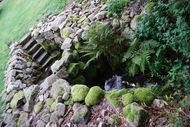
holy well a few hundred meters south of the church in Saint Olaf in Österlen. Was a center of Sankt Olof cult.
September 14, 2013
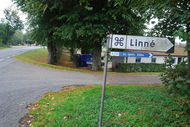
Park at the church parking in Sankt Olof. Just west of the church is a gravel
road down to a farm. The road runs at first along the cemetery wall . At a
half-timbered house is a sign that shows to a grass walking around the
farm. There, at the end of the lawn at the edge of a grove of trees lies the
well, flanked by pasture. In a pasture goes cows. In the east, bordering the
farm.
The well is beautifully paved with stones. A staircase leads down to the
water. At the bottom is a ring of stones around the water. The well is split
into two parts, the one towards the forest leads to one of nettles dominated
opening in the forest. There do I not walk.
Sankt Olof is St. Olaf Haraldsson who was king of Norway, which he christened
with the heavy-handed methods. He was killed July 29, 1030 in the Battle of
Stiklestad in central Norway. His holiness proved by miracles that took place
at his tomb . In the Middle Ages became the well a pilgrimage spot, one
sacrificed money and food for the health and prosperity. The main day was Olof
Day on July 29. On the information plate it says "We found midday entire well
filled with these products, so the water was pretty fat from it and however
people still sat around the well and drank from it."
Lately pilgrim has become popular. Skåne is crossed by the pilgrim
routes, one passes the well. The Church is a pilgrim church. Another well in
Skåne are named after Saint Olaf,
St. Olaf well in Hallaröd
.
Map